
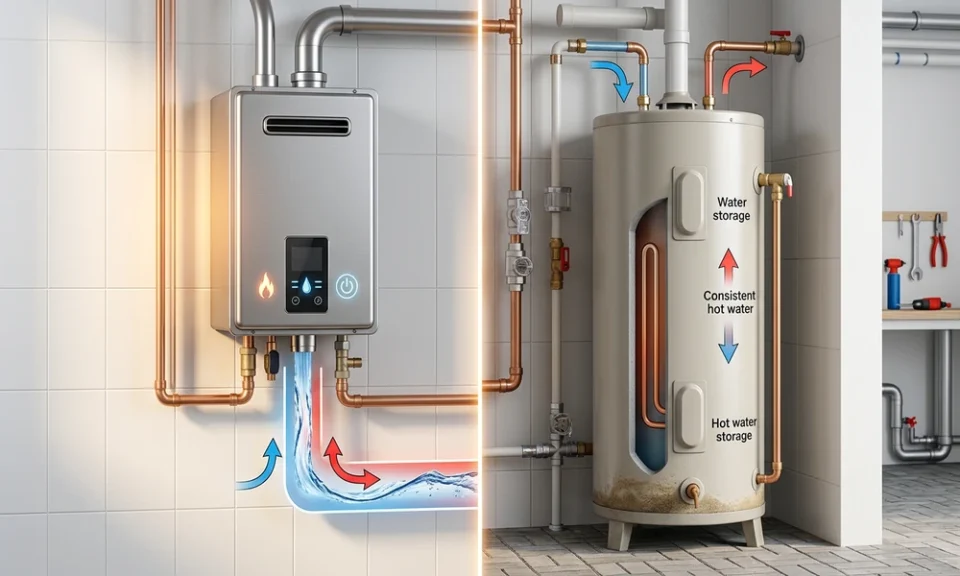
Your water heater fails on a Tuesday morning. You’ve got 45 minutes before work, a cold shower behind you, and a contractor on the phone asking whether you want a tank or tankless replacement. Most homeowners answer that question with a guess. You don’t have to.
The decision between a tankless and a traditional tank water heater comes down to four factors that almost every buyer overlooks until they’re standing in a supply store asking a salesperson to just pick for them. This guide walks you through each one so you can show up knowing exactly what you need.
Why Water Heating Deserves More Attention Than You’re Giving It
Water heating is one of the most energy-hungry systems in your home, and most people treat it like a smoke detector: ignore it until something goes wrong. That’s a costly habit.
According to the U.S. Energy Information Administration’s 2020 Residential Energy Consumption Survey, water heating accounts for 12% of residential electricity consumption , making it one of the three biggest electricity draws in American homes alongside air conditioning and space heating. That share matters when you’re deciding between a system that runs all day versus one that only fires when you turn on a tap.
The type of unit you choose also determines how long you’ll live with that decision. The U.S. Department of Energy reports that tankless water heaters have a life expectancy of more than 20 years, while storage tank models typically last 10 to 15 years. Choosing wrong means replacing the whole system sooner, at full price, all over again.
The FLOW Framework: Four Questions That Decide Your Heater
Here’s the framework I’d put in front of every homeowner comparing these two systems. I call it FLOW, because that’s exactly what’s at stake. Answer all four, and the right choice almost makes itself.
F – Family size and simultaneous demand. How many people shower in the same hour? A tankless unit heats water on demand, which sounds unlimited but isn’t. A single gas-fired tankless unit typically delivers two to five gallons per minute – enough for one shower and a running faucet, not two showers at once. If your household of five hits the bathrooms in a tight morning window, a well-sized tank unit may actually serve you better, or you’ll need two tankless units, which changes the cost math entirely.
L – Location and water quality. Hard water is a tankless unit’s slow enemy. Mineral deposits build inside the heat exchanger and cut efficiency, then eventually cut lifespan. If your area has hard water, annual descaling isn’t optional, it’s survival. Tank units suffer too, but they’re cheaper to replace. Before you decide, know your local water hardness. Your municipality’s annual water quality report lists it.
O – Ownership timeline. Planning to stay in your home for ten-plus years? The higher upfront cost of a tankless system starts paying back through energy savings and a longer lifespan. Selling in three years? A new tank unit checks the box for buyers and doesn’t saddle you with a payback period you’ll never see. The math changes completely depending on how long you’re staying.
W – Wallet position: upfront vs. lifetime cost. A tank unit typically costs less to purchase and install. A tankless unit costs more upfront but runs leaner over time. According to the U.S. Department of Energy, for homes that use 41 gallons or less of hot water daily, tankless water heaters can be 24% to 34% more energy-efficient than conventional storage tank water heaters. That gap narrows in larger households but never fully disappears.
A Real Scenario: The 1960s Craftsman Dilemma
Picture a homeowner in Portland with a 1964 craftsman bungalow, three people in the house, and a 40-gallon gas tank that just sprung a slow leak. Classic replacement scenario. Should they go tankless?
Here’s what actually complicates it: older homes often have undersized gas lines. Switching to a high-output gas tankless unit may require a gas line upgrade, which adds $500 to $1,500 to the install cost right away. If the electrical panel is also at capacity, a hybrid heat pump water heater – which runs on electricity and is dramatically more efficient than a straight electric tank – becomes the smarter pivot.
The point is that the appliance decision can’t be separated from the home’s infrastructure. A supply store with experienced staff will catch this before a truck ever pulls up. Visiting a plumbing fixtures showroom where knowledgeable staff can assess your situation and show you actual units side by side is worth the trip before you commit to anything.
A Side-by-Side Snapshot
| Factor | Tank Water Heater | Tankless Water Heater |
|---|---|---|
| Typical lifespan | 10-15 years | 20+ years |
| Upfront cost (unit + install) | Lower | Higher |
| Energy use pattern | Constant (standby heat loss) | On-demand only |
| Hot water supply | Limited by tank size | Continuous within flow rate |
| Space required | More | Less (wall-mounted) |
| Best for | Larger households, tighter budgets, shorter ownership windows | Smaller households, long-term ownership, efficiency goals |
What Most Buyers Get Wrong at the Purchase Stage
The most common mistake is buying based on unit price alone. A $900 tank water heater looks like a win against a $2,500 tankless unit until you realize the tank will need replacing in half the time, often during a moment of failure rather than planned budget timing.
The second mistake is skipping the sizing step. Tankless units are rated by flow rate and temperature rise. In the Pacific Northwest, incoming cold water can drop significantly in winter, which means the unit has to work harder to hit your target temperature. A unit sized for Miami doesn’t perform the same in Portland in January. Always ask for regional sizing guidance, not just the product spec sheet.
“The right water heater isn’t the most efficient one on paper. It’s the one sized correctly for your home’s actual demand, infrastructure, and water quality.” – A widely shared principle among licensed plumbing supply professionals when advising homeowners on replacement decisions.
Third mistake: ignoring rebates. Many utility companies and state programs offer rebates on high-efficiency water heaters, particularly heat pump hybrid models. Check your utility’s website before you finalize your choice. In some cases, rebates bring a more expensive unit into direct price parity with a basic tank replacement.
Your Pre-Purchase Checklist
- Know your household’s peak simultaneous hot water demand (how many showers at once)
- Check your local water hardness report
- Confirm your gas line size or panel capacity before committing to a fuel type
- Look up available utility rebates in your state or municipality
- Decide your realistic ownership timeline
- Compare total cost of ownership over the unit’s expected lifespan, not just sticker price
The Bigger Picture
Home improvement spending in the U.S. remains historically high: according to the U.S. Census Bureau’s American Housing Survey, American homeowners poured $827 billion into home improvement projects during the two-year period ending in 2023 , a figure that represents more than $200 billion in growth compared to the prior survey period. Water heater replacement is one of the most common projects in that spending pool, yet it’s one of the least planned.
You can change that. Work through the FLOW Framework, build your pre-purchase checklist, and talk to someone who installs these systems every week before you sign anything. The 20 minutes of homework now saves you a decision you’ll live with for the next decade or more.
What’s the single factor that’s been holding up your decision?
